The Rarest Eye Color, in One Answer
Green is the rarest eye color that every chart agrees to count — roughly 2% of the world's population. But the honest answer has a second half: gray and amber are estimated below 1% each, which makes them rarer than green whenever a chart tracks them as their own categories rather than folding gray into blue and amber into hazel.
That single classification decision is why one page tells you green is rarest and the next insists it is gray. Both are describing the same distribution; they just drew the category lines differently.
Here is the full ranking, rarest first, with what each estimate is actually built on. If you want your own eyes placed on this chart from a photo rather than from a mirror guess, the eye color test reads your iris and returns the category plus the rarity estimate.
Eye Color Rarity Chart: Rarest to Most Common
| Rank | Eye color | Estimated global percentage | Rarity |
|---|---|---|---|
| 1 | Violet / red | Under 0.01% | Not a standard category (very low pigment) |
| 2 | Gray | Under 1% | Rarest tracked color |
| 3 | Green | ~2% | Rarest common color |
| 4 | Amber | ~5% | Uncommon |
| 5 | Hazel | ~5% | Uncommon |
| 6 | Blue | 8%–10% | Common |
| 7 | Brown | 70%–79% | Most common |
Read from the bottom up and you get the more familiar framing: brown dominates the planet, blue is a distant second, hazel and amber share the middle, and everything from green down lives in the long tail where definitions matter more than data.
Two things are worth noticing about this table. First, the gap between brown and everything else is enormous — brown alone outweighs all six other categories combined by roughly three to one. Second, the interesting part of the chart is compressed into the bottom 8%, which is exactly where the classification disputes live.
Every Color, Rarest to Most Common
Violet and red — under 0.01%, and not really a color category
Violet-looking eyes are real to look at, but they are not a pigment category. They appear when the iris carries so little melanin that scattered light interacts with the blood vessels behind it, which is why violet is discussed alongside albinism rather than alongside brown and blue.
Charts that place violet at the top of the rarity ranking are technically correct and practically misleading. It belongs in the conversation about unusual eye appearance, not in a like-for-like comparison with the standard categories.
Gray — under 1%, the rarest tracked color
Gray eyes have very little melanin in the front layer of the iris, and instead of the confident blue that low pigment usually produces, they scatter light into a silvery, smoky, sometimes almost colorless slate.
Gray is the category most likely to vanish from a chart entirely, because many sources count it as a variant of blue. When it is counted separately, it usually takes the rarest-color spot outright. How rare gray eyes are covers the estimate in detail, and blue vs. grey eyes covers the call itself, which is the hardest one on this chart.
Green — about 2%, the rarest common color
Green is the answer most people are looking for when they search for the rarest eye color, and it is the defensible one: green is the rarest color that appears as its own category on essentially every chart, in every source, without argument.
It comes from low-to-moderate melanin combined with light scattering, and it is heavily concentrated in Central, Northern, and Eastern Europe — in Ireland and Scotland, green is common enough to feel ordinary despite its 2% world share. See how rare green eyes are for the regional breakdown, and hazel vs. green eyes if your own color sits on that boundary.
Amber — about 5%, and frequently misfiled
Amber eyes are a uniform golden, coppery, or yellow tone across the whole iris. The word "uniform" is doing the work: what separates amber from hazel is not the shade but the absence of zones.
Amber is probably underestimated in the charts because it is so often recorded as light brown or hazel. How rare amber eyes are covers the estimate, and amber vs. hazel eyes covers how to tell them apart in daylight.
Hazel — about 5%, the most complicated category
Hazel is not a shade so much as an arrangement: a warm gold or brown zone around the pupil giving way to green toward the outer iris. That two-zone structure is why hazel eyes appear to change color across the day, and why hazel absorbs so many people who might be classified as amber, green, or light brown elsewhere.
More on the numbers in how rare hazel eyes are, and on the boundaries in brown vs. hazel eyes.
Blue — 8% to 10%, and wildly regional
Blue is the clearest example of why a global chart flattens the truth. Worldwide it sits below 10%; in parts of Northern Europe it is the majority color. Blue eyes contain no blue pigment at all — the color comes entirely from light scattering in a low-melanin iris, the same physics that makes the sky blue.
How rare blue eyes are has the regional figures.
Brown — 70% to 79%, the world's default
Brown is the only eye color found in large numbers on every continent, which is why it dominates the global total so completely. It ranges from light honey-brown through to eyes so dark the pupil is hard to distinguish — a range wide enough that black eye color gets asked about as its own category, though very dark brown is what it actually is.
How rare brown eyes are covers the distribution, and most common eye color covers the other end of this chart in full.
What About Heterochromia?
Heterochromia turns up on nearly every rare-eye list, and it does not belong on this chart — not because it is common, but because it is a different kind of fact. Heterochromia describes a difference in coloration, either between the two eyes or within a single iris. It is a pattern, not a color.
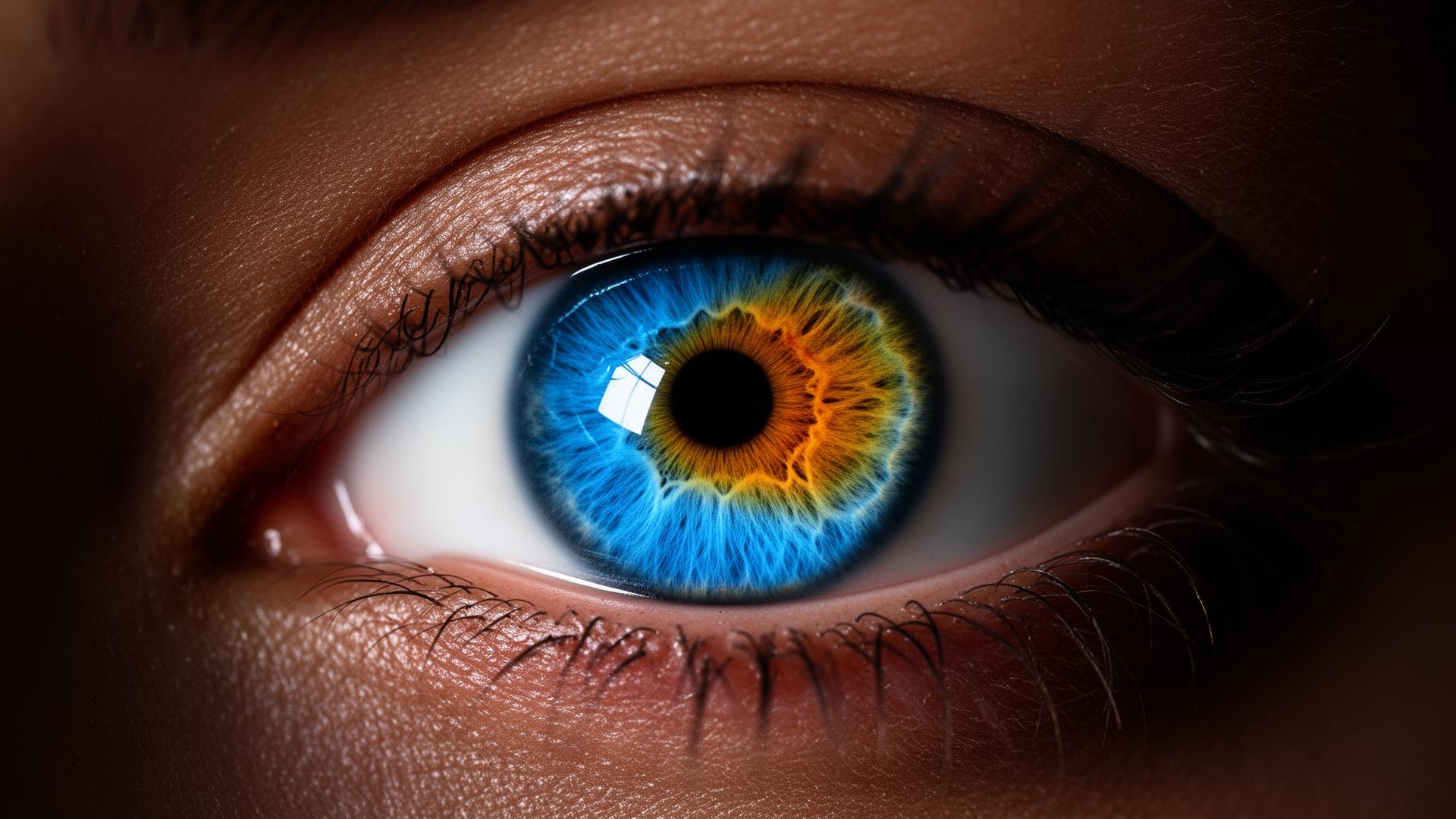
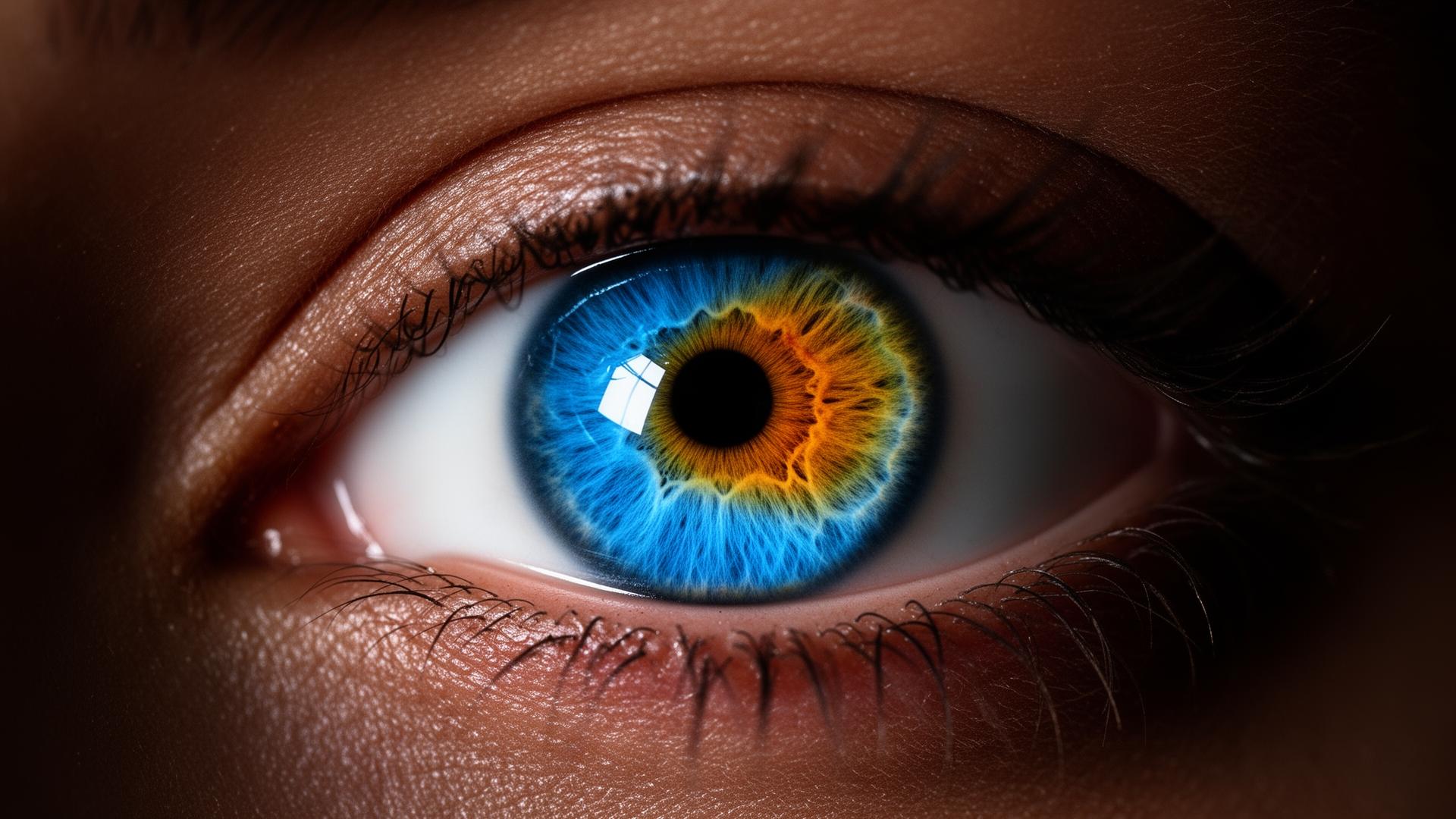
The same applies to central heterochromia, where a ring of one color surrounds the pupil against a different outer iris. Someone with central heterochromia still has a base eye color that sits somewhere on the table above.
Why the Percentages Are Ranges
No worldwide census measures eye color. Every number on this page is a synthesis of regional studies, survey data, and population modelling, which means a chart presenting hard single figures is overstating its evidence.
Three things move the numbers:
- Category definitions. Whether gray is its own color or a variant of blue changes two rows at once. The same goes for amber and hazel.
- Population mix. Global figures are dominated by the regions with the most people, and most of the world lives in brown-dominant regions.
- Lighting and self-reporting. Much of the underlying data is self-reported, and people classify their own borderline eyes inconsistently — the same hazel-green iris gets recorded three different ways by three different people.
A chart that shows ranges and explains the disagreement is more useful than one that shows decimals it cannot support.
How Region Changes the Whole Picture
Stack the regional distributions and you can see where the global chart comes from. Across much of Africa, Asia, and the Middle East, brown approaches near-universality — that alone sets the worldwide brown figure.
In Northern Europe the picture inverts: blue can be the majority color, gray becomes noticeably more common, and green climbs well above its 2% world average. In Estonia, Finland, and Iceland, a light-eyed majority is normal.
The practical consequence is that rarity is relative. A color that feels unremarkable in your family or your country can still be globally uncommon — and the reverse is just as true.
Finding Your Own Place on the Chart
The chart is a comparison tool, not a diagnosis. Most people who cannot place themselves on it are not failing at it; they have mixed tones that a seven-row table was never going to capture.
Two things make the comparison honest:
Judge base color first, then undertones. Look at the mid-iris for the dominant color before you look at anything else. The ring around the pupil and the outer limbal ring are what push people toward the wrong category — a warm pupil ring on a green iris reads as hazel at a glance, and it is the most common misclassification on this chart.
Use neutral daylight, no filters. Warm indoor light turns hazel into amber and amber into brown; an overcast day by a window is the fairest test condition you will get. Then check whether your iris shows one color family throughout (amber, brown, blue, gray) or distinct zones (hazel, many greens).
If your eyes are hard to place after that, an eye color analyzer will read the iris from a photo, report the undertones, and return the rarity estimate from this chart — which is the part a mirror genuinely cannot do. Whatever it returns, remember what the bottom of the table says: everything below blue is rarer than 90% of the world, and that includes a great many people who assumed they were ordinary.